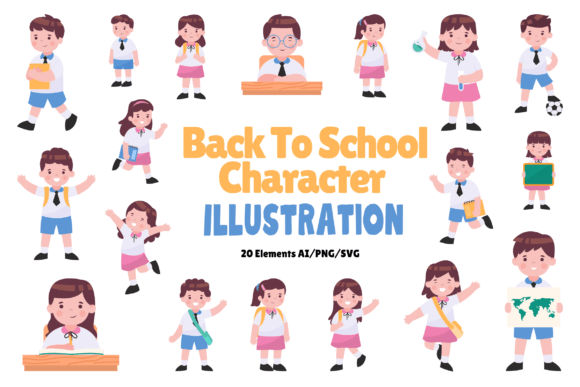
Back to School Character Illustration: Practical, Adaptable, and Ready for Real Creative Work
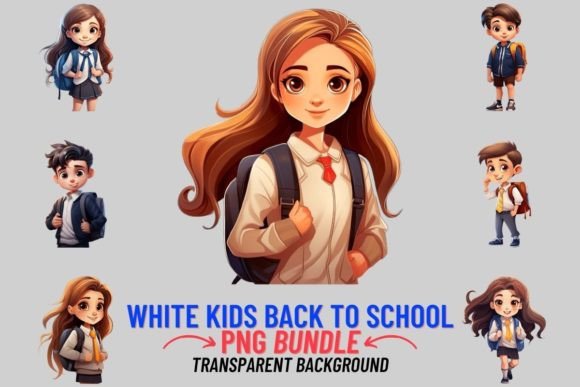
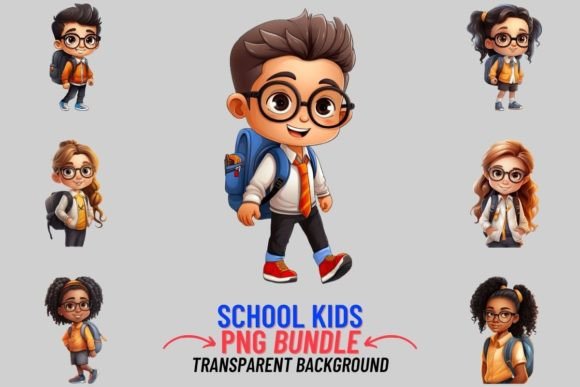
Back to school season isn’t just about notebooks and backpacks anymore—it’s a creative moment. Educators design welcoming classroom environments, small businesses launch seasonal promotions, content creators refresh social feeds with relatable visuals, and indie makers craft limited-edition stationery or apparel. At the heart of much of this work is a quiet but powerful need: authentic, flexible, and inclusive visual storytelling. That’s where Back to School Character Illustration steps in—not as generic clipart, but as a thoughtfully curated set of 20 isolated, activity-based characters that reflect real moments in learning: a child raising a hand, sketching in a notebook, building with blocks, reading under a tree, coding on a tablet, sharing snacks at lunch, collaborating on a group project, and more.
Why These Illustrations Fit How People Actually Design Today
Modern design workflows are hybrid by necessity. A teacher might start in Canva to build a welcome poster, then export to Photoshop to add texture overlays. A boutique stationery brand may begin with vector assets in Illustrator for scalable packaging, then repurpose PNGs with transparent backgrounds for Instagram Stories or Etsy product mockups. This collection supports that fluidity: each of the 20 elements arrives in AI, SVG, and PNG formats—no conversions needed, no quality loss when resizing, no guesswork about compatibility. The PNG files are true clipart: crisp, background-free, and instantly usable over photos, gradients, or solid colors. Vector files (AI, SVG, EPS) retain full editability—change stroke weight, adjust proportions, recolor individual limbs or accessories without pixelation. That flexibility matters when you’re iterating fast across platforms and audiences.
More Than Nostalgia—A Shift Toward Intentional Visual Language
There’s been a noticeable shift away from overly polished, stock-photo-style education imagery. Today’s audiences respond better to warmth, diversity, and subtle narrative—details like mismatched socks, expressive hand gestures, varied skin tones, adaptive tools, or bilingual labels. These illustrations don’t just depict “a kid in school.” They show curiosity, collaboration, quiet focus, joyful movement, and gentle support. That nuance aligns with how educators, marketers, and designers now think about representation—not as an afterthought, but as foundational to clarity and connection. It also reflects broader expectations around authenticity: learners, parents, and customers can tell when imagery feels observed rather than assembled.
Real Uses, Not Just Possibilities
When we say these illustrations work for branding, social media, stickers, or nail art—we mean it in practice, not theory. Consider:
- A homeschool co-op uses the “reading nook” and “science experiment” characters to design printable weekly planners—customizing colors to match their seasonal theme (e.g., warm terracotta for fall, soft sage for spring).
- An edtech startup integrates the “tablet coding” and “group presentation” figures into onboarding tooltips and feature announcements—keeping UI visuals friendly and context-specific without needing custom illustration per release.
- A small-batch enamel pin maker selects three characters—“raising hand,” “painting at easel,” and “building with blocks”—and layers them over geometric patterns in Illustrator to create cohesive sets for back-to-school pop-up shops.
- A K–5 counselor adapts the “deep breathing” and “sharing circle” illustrations into laminated emotion cards, adjusting hues to match their classroom’s calm-down color system.
None of these require advanced illustration skills—just clear intent and the right starting assets. That lowers the barrier for educators building resources in-house, solopreneurs managing their own marketing, or nonprofits refreshing materials on tight timelines.
Customization Without Compromise
Color isn’t just an aesthetic choice here—it’s functional. The ability to recolor any element means one illustration can serve multiple purposes: a blue version for a district-wide literacy campaign, a coral-and-teal version for a private Montessori school’s newsletter, and a monochrome version for high-contrast accessibility needs. Because all elements are delivered as clean, layered vectors (not flattened artwork), users can isolate hair, clothing, or props and assign distinct swatches—no manual masking or selection required. Even in raster programs like Canva or Photoshop, the transparent-background PNGs allow non-destructive layering over photos, textures, or gradients, preserving depth and intentionality.
Where Format Choice Actually Matters
It’s worth pausing on format—not because technical specs are exciting, but because they directly impact what you can do, and how long it takes. PNGs shine in fast-turnaround digital contexts: social banners, email headers, website icons, or print-on-demand mockups where resolution up to 300 DPI is sufficient. Vectors (AI, SVG, EPS) become essential when scaling beyond standard print sizes—think large-format posters for school hallways, embroidered patches, or laser-cut wood signs. SVG files also integrate cleanly into web development workflows, enabling CSS-driven color shifts or responsive animations without loading heavy image files. Choosing the right format isn’t about expertise—it’s about matching tool to task, and this collection removes the friction of switching between them.
Designing With Purpose, Not Just Decoration
Back to school visuals often default to broad themes—apples, pencils, chalkboards. But children’s experiences are richer and more specific. A “child organizing supplies” illustration communicates preparedness and routine. A “student helping a peer tie shoes” signals community care. A “kid using sign language during circle time” affirms inclusion as visible practice, not abstract policy. These aren’t decorative flourishes; they’re visual shorthand for values. When used deliberately—in classroom rules posters, parent communication templates, or brand guidelines—they reinforce culture, clarify expectations, and reduce cognitive load for young audiences still developing literacy and emotional vocabulary.
What You Get—and What That Enables
You receive 20 isolated, activity-based character illustrations—no bundles, no filler, no overlapping scenes. Each is built with consistent line weight, balanced proportions, and intentional negative space, so they mix well with typography, patterns, or photography. They’re not locked to one style or era; they’re designed to age gracefully alongside your projects. Whether you’re updating a school’s annual report, launching a new line of teacher appreciation mugs, designing interactive lesson slides, or illustrating a children’s book manuscript, these elements serve as reliable, editable anchors—not placeholders waiting to be replaced.
A Resource That Grows With Your Needs
This isn’t a trend-driven asset pack meant to feel fresh for six weeks. Its strength lies in adaptability: the same “library corner” figure works for a public library’s summer reading program, a preschool’s orientation guide, or a literacy nonprofit’s donor newsletter. As workflows evolve—say, toward more motion graphics or AR-enhanced print—the vector foundation ensures these characters can be animated, 3D-extruded, or embedded into interactive prototypes without degradation. And because they’re delivered as individual files—not one massive collage—you only use what serves your current goal. No bloat. No overhead. Just clarity, consistency, and creative room to breathe.