Asian Kids Back to School Sublimation
Back-to-school season isn’t just about notebooks and lunchboxes—it’s a powerful storytelling moment. For creators, educators, and small business owners, Asian Kids Back to School Sublimation offers more than decorative appeal: it’s a thoughtful, culturally grounded visual resource that supports inclusion, authenticity, and creative flexibility. Whether you’re designing classroom posters, custom apparel for school events, multicultural lesson plans, or digital learning tools, this collection bridges aesthetic quality with real-world usability.
What It Is—and Why It Matters
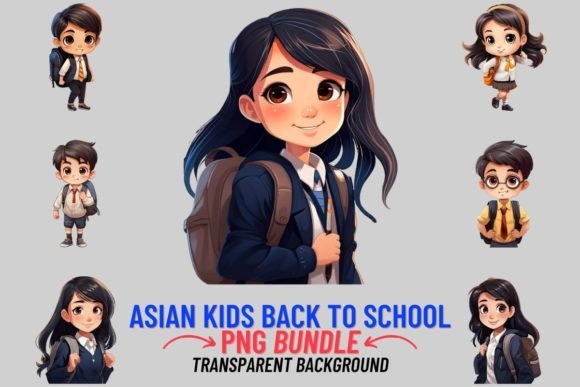
This isn’t generic clipart. The Watercolor Asian Kids Back to School collection features 16 high-resolution PNGs—each with transparent backgrounds, 300 DPI resolution, and dimensions up to 4096×4096px (13×13 inches). The watercolor texture adds warmth and artistry without sacrificing clarity, making the files equally effective on screen and in print. Unlike vector-only assets or low-res downloads, these images are purpose-built for both digital projects (e-books, websites, Canva templates) and physical applications (sublimation mugs, tote bags, bulletin board displays, or laminated flashcards).
Importantly, the children depicted reflect diverse East and Southeast Asian features, clothing styles, and expressions—avoiding stereotypes while honoring everyday school readiness: backpacks zipped tight, pencils tucked behind ears, smiles full of anticipation. That specificity matters—not just for representation, but for resonance. A teacher using these in a kindergarten welcome packet doesn’t just add color; they signal belonging.
Common Missteps—and How to Avoid Them
Even experienced designers sometimes overlook subtle but critical details when selecting sublimation-ready assets. Here’s where things go off track—and how to stay aligned:
Mistake: Assuming “PNG” means “ready for all uses”
Not all PNGs are equal. Some claim transparency but contain faint white halos or anti-aliasing artifacts that bleed during sublimation or large-format printing. Others are upscaled from smaller originals, losing crispness at 13×13 inches. This leads to blurry transfers on tumblers or pixelated banners—wasting time, ink, and materials.
Better approach: Verify resolution *before* download. Look for explicit confirmation of 300 DPI *at full size*, not just “high-res” as marketing fluff. Test one file at 100% zoom in Photoshop or GIMP—if edges look soft or jagged, it’s not production-ready.
Mistake: Overlooking color behavior in sublimation
Watercolor textures rely on subtle gradients and soft edges—but sublimation printers interpret RGB differently than monitors. What looks vibrant on screen can mute or shift (especially pinks, teals, and warm skin tones) on polyester fabric or ceramic blanks.
Better approach: Use the included PNGs as a starting point—not a final output. Adjust saturation and contrast slightly in your design software before sending to print. For best results, run a small test transfer on scrap material first. If you’re creating merch for resale, document those adjustments so future batches stay consistent.
Mistake: Using school-themed art without checking cultural context
Generic “back-to-school” imagery often defaults to Western uniforms, apple motifs, or cartoonish tropes. When used in multicultural classrooms or global e-learning platforms, that disconnect can unintentionally marginalize students—or worse, feel tokenizing.
Better approach: Choose assets where diversity is embedded in the design process—not added as an afterthought. These Asian Kids Back to School Sublimation files were created with intentionality: no exaggerated features, no props that stereotype (e.g., chopsticks instead of pencils), and natural, joyful body language. That authenticity builds trust—whether you’re a curriculum developer or a Shopify seller launching a back-to-school line.
Mistake: Skipping file organization and naming
With 16 files, it’s easy to lose track—especially if filenames are vague (“kid_03.png”) or inconsistent. Later, when building a slide deck or batch-printing labels, confusion slows progress and risks mislabeling or duplication.
Better approach: Rename files meaningfully right after download: asian-girl-backpack-blue-watercolor.png, asian-boy-notebook-smiling-watercolor.png. Add a quick text file listing each child’s implied age range, expression, and key colors—helpful for educators aligning visuals with SEL themes or marketers matching tones to brand palettes.
Before You Download or Design: A Quick Checklist
- Confirm technical specs: Are files truly 4096×4096px? Do they open cleanly in your preferred software (Photoshop, Affinity, Cricut Design Space)?
- Check licensing scope: Does the license cover commercial use—including sublimation products sold online? Are there restrictions on quantity or attribution?
- Assess versatility: Can you layer these over photos, integrate them into SVG cut files, or animate them lightly for digital lessons? The watercolor style should complement—not compete with—other design elements.
- Think beyond the screen: Will this work on matte paper banners? On glossy sublimation mugs? On fabric face masks? Soft watercolor edges hold up better than sharp vectors on textured surfaces—so test across mediums early.
Real Projects, Real Impact
A homeschool blogger used three of these images to illustrate a “First Day Traditions Around the World” printable—pairing each child with a short paragraph about school rituals in Japan, Vietnam, and South Korea. Because the art felt cohesive and respectful, parents shared it widely in multilingual parent groups.
A small-batch apparel shop printed the same set onto organic cotton drawstring bags—paired with simple typography like “My Name Is…” and “I Love Learning.” No stock photos, no AI-generated faces—just real-looking kids, rendered with care. Their best-selling item? The version featuring a girl adjusting her glasses while holding a notebook—because it quietly affirmed neurodiversity without labeling it.
An elementary ESL teacher embedded the PNGs into interactive Google Slides, adding voice recordings of vocabulary words in Mandarin, Tagalog, and Korean. Students clicked on each child to hear phrases like “This is my backpack” spoken by native speakers. The watercolor softness reduced visual overwhelm—especially for younger learners.
These aren’t edge cases. They’re reminders that Asian Kids Back to School Sublimation works best when treated as a tool—not just decoration. It gains value through thoughtful integration, technical awareness, and respect for its cultural grounding.
If you’re building something meant to educate, inspire, or connect—start with assets that do more than fill space. Start with clarity, consistency, and quiet confidence. That’s what this collection delivers: not just pixels, but presence.